What probability of profit answers
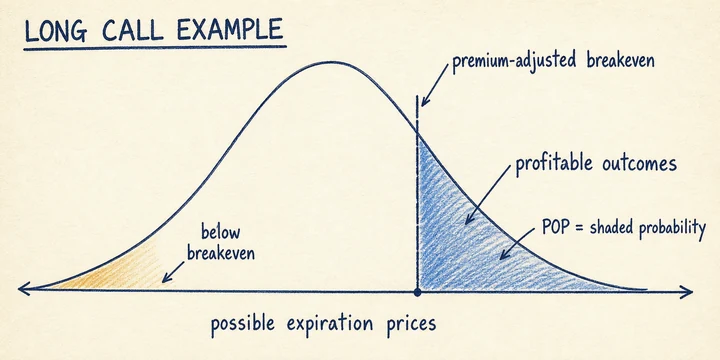
Option probability of profit, usually shortened to POP, estimates the chance that a position finishes profitable at expiration under a defined statistical model. It is not the chance that the option merely finishes in the money, because the premium paid or received moves the price where the trade actually breaks even.
OptionsPeek currently calculates long-position probability of profit for purchased calls and puts. When a supported contract has the required market details, the percentage is calculated automatically from the contract you are already viewing—there is no separate POP form to complete or duplicate set of inputs to enter.
Long does not mean call
An option position has two separate labels. Call or put describes the type of contract. Long or short describes how you entered the position. Keeping those two ideas separate makes options language much easier to follow.
Long means you bought the option and paid a premium. You can own a long call, which generally benefits from the stock rising, or a long put, which generally benefits from the stock falling. Both positions are long because you purchased the contract; the word does not predict whether you want the stock to go up or down.
Short means you sold or wrote the option and received premium. Short-option probability and risk are different from the purchased-option calculation shown here. OptionsPeek currently treats Entry option price as premium paid, so Probability of profit on the contract card is the long-position result for either a call or a put.
Breakeven comes before probability
For a long call, expiration breakeven is the strike price plus the premium paid. A $100 call purchased for $5 needs the stock above $105 at expiration to be profitable before fees.
For a long put, expiration breakeven is the strike price minus the premium paid. A $100 put purchased for $5 needs the stock below $95 at expiration. The POP calculation evaluates the probability of finishing beyond that breakeven, not just beyond the strike.
Inputs used by the probability model
A useful option POP estimate needs the current stock price, strike, option premium, current implied volatility, and exact time remaining until expiration. Interest rates and expected dividend yield also affect the modeled distribution.
OptionsPeek uses a lightweight lognormal calculation related to the Black-Scholes framework. It reads the required details from the viewed contract, computes POP automatically when those details are available, and updates the result when the entry premium changes.
Why Delta is only a shortcut
Traders sometimes use absolute Delta as a quick probability estimate, but Delta and probability of profit answer different questions. Delta is an option-price sensitivity, and its common probability interpretation is closer to finishing in the money than finishing beyond a premium-adjusted breakeven.
That distinction matters most when the option premium is large. The farther breakeven sits beyond the strike, the more a Delta shortcut can overstate the chance that a long option trade is actually profitable at expiration.
How to use POP in OptionsPeek
View or select a supported option contract and OptionsPeek uses the stock price, strike, option price, expiration, and current IV already on the page. When those details are present, Probability of profit appears automatically on the Option contract scenario card; it is not a separate mechanical calculator that asks you to rebuild the contract by hand.
Open the Profit / Breakeven calculator to review expiration POP beside premium paid, expiration breakeven, estimated scenario-date position value, and estimated P/L. The current contract premium is the shared default in both views; changing Entry option price immediately changes breakeven, POP, and the scenario P/L basis.
What the percentage does not guarantee
POP is a model estimate, not a forecast. Implied volatility can differ from realized volatility, and actual results can change with dividends, rates, early exercise, assignment, liquidity, spreads, commissions, and event risk.
Use probability of profit as one planning input alongside payoff, maximum loss, position size, Greeks, and the quality of the live option market. A higher modeled POP does not automatically make a trade better.